One common thing that most Potawatomi still live with, is the pain of what is known as "Indian boarding school" a horrible event that many have forgotten and as time moves so does the healing, it still remains a part of so many Potawatomi, a sort of excess baggage, it shows it's ugly face in the form of poverty and substance abuse. Potawatomi is the late 1930's and up, had to attend Indian boarding schools for many reasons, none of them good.
Indian Boarding Schools came to be from Mr. Pratt who believed that society could take "the Indian out of the child" by removing them from his or her home. And teaching Potawatomi children what was seen as the right way to act and behave, one could not speak the only language that was known. The Potawatomi, were taken far away from home, and sometimes they were used to do manual labor, Many times parents and children were separated from each other for what seemed like a lifetime, for the victims of these schools, it would leave a deep scar, one that would affect generations later.
Boys were introduced to the schools by being forced to get hair cuts, the hair was part of a deep sense of culture. Then the boys were forced to have their tonsils removed. No one ever knew why?
Children were forced to conform to the religion of the school that held them captive. Punishment was severe and many times cruel, resulting in many children trying to run away back home to the love of the only family that they knew. Tensions grew at these schools and resulted in fighting, many times over nothing other than pure misery, this pain and violence would follow many Potawatomi generations later. End
Potawatomi learned how to survive and thrive, and today many accomplishing great things, we have so many Professors, lawyers, actors, actresses, professional athletes, musicians and one of the most important Potawatomi's, the one that is alive today. The change in the government and America's views of the Native American although FAR from perfect, it is certainly better than what it once was, it is VERY important to remember the past, it is also important to look to the future.
Our student roster for the Mt. Pleasant Boarding School. I see my grandma's name on this list along with many families that I know today. It is amazing how many names you will recognize just from reading our newsletters with this list. (To see the student roster just click the title of this story).
There was a lot of time to think during the White Bison's Wellbriety Journey to Forgiveness, the five mile walk held at Mt. Pleasant on June 17. The Saginaw Chippewa Indian Tribe of Michigan Indians should be proud to have hosted such a momentous event.
American Indians-and some non-Indians-from all directions of Michigan came to Mt. Pleasant to walk side by side to support the idea of forgiveness to the non-Indians who encamped generation after generation of American Indian children in boarding schools. We came from cities, rural areas and reservations to voice support for the call for an official apology from President Obama on behalf of the United States government.
Even though we-some 500 American Indians-had to brave a rainy beginning of the walk, the inconvenience was trivial in comparison to the suffering by those generations of American Indians who were forced to attend the boarding schools.
During the walk many musings flooded my mind.
I thought about my deceased grandmother. Ellen Whitepigeon, who was taken from her family on the Prairie Band Potawatomi Nation and placed in an Indian boarding school at Genoa, Nebraska. I thought about the tattoo-which remained until she died at 89-on her forearm used to identify who she was during her encampment there. I thought about how the Nazis tattooed Jews in concentration camps.
I thought about the sheer agony suffered in the hearts of American Indian parents when someone arrived at their doors to take their children away from the protection of their family's love and culture. I thought about the tragic scars left on the souls of American Indians as the result of losing their family's protection.
I thought about the whole crazy scheme concocted by General Pratt to "kill the Indian and save the man," As I looked around and witnessed my fellow Indian marchers. I thought Pratt's system did not fully succeed. I saw strength of survivalists on the faces of my fellow Indian marches- especially our great elder George Martin, who is approaching 80 and who walked every mile of the journey.
I thought how must non-Indians don't even know what we are talking about when we mention Indian boarding schools. I thought about how they look at us as if we make up stories of sever punishment Indian kids endured because they wanted to speak in our Native tongues.
I thought about how we American Indians are often accused of wanting to stay in the victim mode when we should simply "get over it and forget" about what happened to our ancestors. I thought about how Jews purposely have a saying "Lest we forget" so that the world acknowledges they will never endure another Holocaust.
I thought about just how few media covered the walk. I thought if we Indians were fighting one another that day, the media coverage would have been three times larger.
Along the journey to the Mt. Pleasant Indian Industrial Boarding school, the walkers stopped by the Isabella County Courthouse to hear remarks by non-Indian elected officials who voiced their support for an apology. Even though they were well intentioned, many of the words seemed to come out flat and rehearsed as I heard them.
On the grounds of the Mt. Pleasant Indian Industrial Boarding School, we were greeted by the thunderous sounds of drum and singing as we walked into the tent. The crowd suddenly swelled to some 600 because we were joined by those who could not physically make the five mile walk.
As I looked around the crowd against the backdrop of the closed boarding scool, I mused I am proud to have been Ellen Whitepigeons grandson and I was glad I journeyed to Mt. Pleasant in her memory.
By Levi Rickert, my cousin, a tribal member of the Praire Band Potawatomi Nation. He is the former director of the North American Indian Center. And can be reached on Facebook.
(Click on the title of this story for the actual story)
My grandmother also was sent to this same school, not by choice, not by desire, by force. I have heard the stories of this school and still live with the memories of a school I was never forced to attend. It was a long time ago, but the memories still exist to many, some are still alive.
"Man recalls life at Mount Pleasant Indian school"
John Crampton, a member of the little River Band of Ottawa Indians, still remembers the days when he attended the Mount Pleasant Indian School at age 6. Eighty-three years later, as he walked the grounds of the former school, he reminisced about his childhood.
"That was the big boys dormitory," Crampton said, "over there was a deer pen. The buildings for the teachers and staff was over there."
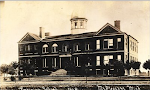
The Mount Pleasant Indian Industrial School operated in Michigan from 1893-1933. The school, at peak enrollment, had about 150 girls and 175 boys from the Chippewa, Ottawa and Potawatomi tribes, according to documents at the Mount Pleasant Center.
An excert from October 1, 1889 report from the Commissioner of Indian Affairs shows what the U.S. government's mind-set was like at the time: "The Indians must conform to the white man's way, peaceably if they will, forcibly if they must," the report stated.
The removal of Native American children from their families and communities was the U.S. government's intentional plan to assimilate the Indians into white Euro-American society during the period between 1880 and the 1920s, according to Alice Littlefields research on the Bureau of Indian Affairs' Boarding Schools, "Theories of Resistance and social Reproductions."
Crampton pointed to the boarded-up brick buildings still standing on what is now the Mount Pleasant Center. "The sidewalk is still here," he said. "I imagine these trees were here when I was here".
"The girls were on the other side from the boys. We had an ice house, a stable, a gym, and I learned how to swim in the creek just north of here," he said.
Crampton has fond memories of friends, regular meals and clean clothes. "If it wasn't for this school, I would have starved to death. I liked the uniforms. They were warm," he said. Crampton said he learned how to cut hair at the school and attended church.
Thousands of American Indian children from Michigan and other states attended the federally run school. Saginaw Chippewa Tribe mamber Carole Tally said both her parents were sent to the school. "It was a very depressing time for the family," she said. "They just came in and took kids."
In the community of her mother, Nellie Ashmum, people were scared when they saw white people coming around because they thought they would be taken away. "My dad, he had to be sent away" as a young child, Tally said. "He had negative feelings about jis (boarding school) experience. He used to be a basket maker, and they wouldn't let him do it anymore."
In 1991, Crampton and about 12 other elders, who attended the Mount Pleasant school, discussed their experiences at a reunion organized by Paul Johnson of the Michigan Education Association. Johnson facilitated a recorded discussion with the elders from Ojibwa, Chippewa, Ottawa and Potawatomi communities about their experiences living at the school.
According to official documents at Ziibiwing, "The establishment of the school in 1893 and its closing in 1933 were the result of shifts in federal Indian policy changes in education, philosophy and changes in the U.S. economy."
About 50 boys and girls enrolled in the school when it closed were labeled orphaned and housed in dormitories and sent to public schools, according to the Isabella County newspaper. The state designated the original Indian Industrial school Chapel and Indian Cemetery as historical landmarks in 1987.
The Indian boarding school era historically has been blamed for the decimation of the Native American culture and their disconnection with tradition, heritage, and most especially , the language of Native American people.
In 1926, they made Indians citizens but it didn't make a lot of difference to Indians back then because they were still Indians. My grandmother was sent to this school and the reason I tell you this story is so everyone will understand partially how Native Americans got to the point were Indian Health Services would be granted along with a whole slew of other rights that would be granted to the Native American. An effort by the U.S. government to restore and save the endangered Native American, and why not we save endangered animals.
,+Karen+Bush+Gibson,+Ex-+-+eBay+(item+360233250981+end+time+Mar-09-10+19-22-27+PST)_1265816805474.jpeg)


_1268194840228.jpeg)





+-+Scaled+(81%25)_1268659179492.jpeg)
_1260635199802.png)



_1258923894209.jpg)
_1264507440700.jpeg)




+-+Scaled+(44%25)_1259783064296.png)
_1259283627752.jpg)

_1259774178454.jpg)



_1259767645072.jpg)

_1259771686595.jpg)

_1259768512068.png)
_1259785323010.jpg)
%2B-%2BScaled%2B(78)_1259784212872.jpg)